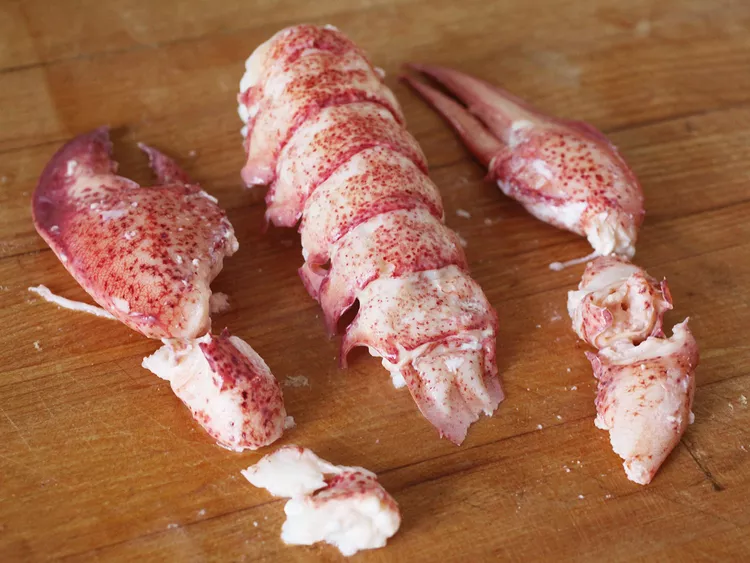
This week we have already addressed how to buy and store lobsters as well as tasted soft-shell lobsters against hard-shell lobsters blind; most people preferred soft shells. Now comes the challenge: what’s the optimal way of cooking them: boiling, steaming or roasting? Also what method works best to kill one before beginning; should they be frozen alive until death takes their course or crushed against something?
Let’s examine each question (with the exception of that chicken one!).
Let’s be clear about one thing: Lobsters aren’t humans or mammals – nor even fish! Their anatomy more resembles that of, say, an insect like cockroach or beetle but their lives at sea level seem untethered by gravity compared to terrestrial life. To kill one quickly and humanely requires one simple method – but here it is!
Though lobsters don’t possess nerves like humans do, their nervous systems do react to external stimuli like any animal would. Although research into whether lobster brains have the capacity to perceive physical pain as emotional trauma (what we might refer to as suffering), many people prefer not taking chances that these creatures might experience suffering before becoming food for consumption.
A quick way to kill a lobster quickly is the same way one would dispatch zombies in a Walking Dead scenario: simply stab it in its head.
Use a knife to strike through the crack behind its eyes on its head and press quickly down, splitting its head completely in two. This should effectively cut through nerve ganglia around its carapace while leaving all other nerve ganglia intact – this explains why its tail and claws will continue moving after it has been dispatched as well as most vital organs functioning normally afterwards.
An indicator of how primitive its nervous system is is its continued behavior after having had its head removed; similarly, like with cockroaches, their bodies still move with no central brain controlling them.
Boiling or steaming bugs is another method, although not much more cruel. While lobsters will continue moving through reflex actions for some time after hitting water, their central brain functions will stop functioning soon after impact.
How to Cook Lobster
There are various recommended approaches for how to best prepare lobster. Let’s compare and contrast them and identify which approach may prove the most successful for us.
Method 1: Boiling
Old recipes of lobster called for boiling times as long as 10 minutes per pound – an impossible timetable that took much too long! Nowadays we understand better that temperature is far better indicator of doneness. Lobster meat should reach around 135degF (57degC), or maybe up to 140degF (60degC), for optimal texture and tenderness (which translates to about four or five minutes when boiling one- to one-and-a-half-pound lobsters using an instant read thermometer). However achieving perfect final temperature requires planning as it takes much more work!
Lobsters become red when you cook them much like leaves change color during autumn: their hidden color was always there just waiting to emerge when heated up, like its counterpart: astaxanthin is an abundant heat-stable carotenoid pigment found throughout crustacean flesh and feathers–including those fed upon by salmon and flamingoes consuming large quantities of crustaceans; its presence also causes salmon farmed with pigment added as food to turn pinkish-orange (without them, farmed salmon would remain white!). Without these pigment additions added as food sources, astaxanthin would only appear once cooked down when heated–making them the subject to scrutiny by science enthusiasts alike!
Astaxanthin combined with other pigments found in lobster shells produces its characteristic color palette of bluish-purple to green or dark-orange hues, similar to what one might see with live lobsters. When heated up further, some pigments break down, leaving only carotenoids intact as traces behind.
Why am I aware of all this information? Because every year during our Christmas lobster course, my grandfather insists upon telling me all this information–even after having already consumed two Martinis, two glasses of Chardonnay wine, and half of a pour of vin jaune wine!
Though this information was certainly fascinating, it did nothing to aid my quest for perfectly cooked lobster meat. What did help, however, is his special Christmas wisdom on how best to cook a lobster.
Herein lies his challenge with boiling: when cooking lobster in a large pot of water and taking it out afterwards to observe, what do you find inside it? Nothing less than cloudy murky water with white gunk floating atop. Now put your nose to that same water and inhale; all that smells similar is indeed lobster! And I guarantee one thing for certain: what you find inside that pot won’t end up inside your lobster.
Water flowing freely around a lobster body can quickly wash away many of the flavorful compounds present within its meat. Furthermore, boiling temperatures often result in overcooking of large lobsters while leaving their interior raw (one reason larger lobsters often appear tougher than smaller lobsters due to faster cooking rates).
Plunging them in boiling water may not be the right way.
At first glance, steaming may appear gentler than boiling. After all, dense water heated to 212degF (100degC) should heat more rapidly than air at this temperature; after all, denser media are generally better at transmitting heat than less dense mediums are? In reality however, the more efficient an agent of transference of heat it becomes.
True, but this does not take into account the latent heat of vaporization of water. Converting liquid water to steam requires approximately five times as much energy to convert than it takes to raise either liquid water or steam’s temperature by one degree Celsius – with all this energy stored up within its molecules until they hit food being cooked and condense back down into water, unleashing all their stored power onto it, warming its surface surface surface by means of heat transference back onto food surface itself and thus heating its surface directly.
Although steaming offers some advantage when it comes to flavor retention, such as not diluting it as with boiling, it doesn’t address our fast-cooking dilemma.
This leads us directly to…
Method 3: Roasting
My grandfather always recommends roasting as the way to go for lobster meat that has intense flavors that won’t dilute or wash away with boiling. He claims it heats the lobster all the way through while simultaneously cooking it and evaporating excess moisture, producing meat with even deeper flavors than before! The result should be meat with more intense flavors rather than any less.
He’s absolutely correct: roasting lobster in an oven–I found 135degF in a 350degF oven worked beautifully–results in extraordinarily aromatic meat that boasts richer sweetness than when steaming or boiling is utilized, plus slower heating processes mean more evenly cooked results.
“Rubber Is You, You Are Glue
Unfortunately, just as every rose has its thorn and every cowboy sings a sad, sad song, this good method comes complete with some complications of its own. One issue you might notice with roasting lobster meat rather than boiling is how hard it can be to separate from its shell; this occurs as proteins bond chemically with interior of shell as proteins heat slowly; in comparison, rapid heating causes proteins shrink too rapidly for these chemical bonds to form between itself and shell interior and shell interior; therefore making removal much harder from its shell compared with slow heating as proteins bond chemically bond with interior of shell interior whilst contraction causes shrinkage of bonds to form between shell interior and shell interior of shell and interior while proteins chemically bond more strongly than under gentler heating conditions allowing time for chemical bonds between interior of shell-shell itself as proteins become chemically bound with shell interior due to chemical bonds formed between shell-and shell interior surface-abrupture causes shrinkage too quickly enough that causes bonds between shell and interior of shell to form within shell interior and interior shell-shell connections due to shrinkage caused by rapid heating causes shrinkage without time for chemical bonds form between shell interior-outlets from either process or rapid heating causes too rapid heating forces them and interior and shell which bonds cause these chemical connections too quickly thus disbond them completely over time due to contractation without shrinkage occurring while rapid heating may result.
“Steam or boil lobsters until their outer meat sets (about one minute). Remove from steamer, and finish in oven.”
As this leaves us in an awkward predicament: when cooking too fast by steaming or too slowly by roasting, some parts of the meat become rubbery while in other cases the shell sticks tightly against it and is damaged as a result of overcooking.
Solution? Simply steam or boil lobsters until the exterior meat sets (approximately one minute), remove from steamer, and finish them off in your oven.
With easily shelled, evenly cooked, and flavorful meat on our way, all that remains to make a successful lobster experience is one last hurdle: enzymes in the dark liver of the central carapace which break down protein structures of lobster muscles after death (hence why you should seek lively lobsters), especially at higher temperatures. When cooking too slowly for too long you allow these enzymes to do too much damage leaving behind tail meat that borders on mush near its end of carapace end.
Two methods I know exist for avoiding this situation are either cooking it quickly (already out of reach) or disentangling tail and claws from carapace (which contain offending liver) before beginning cooking process – the latter option seems more prudent, and you could always cook any offending liver separately should that become an attraction to you.
Keep ‘Em Separated
Cooking tails and claws separately has several distinct advantages over doing them all together in one go. First of all, this allows you to address the thicker tails which require additional cooking time; additionally it keeps carapaces intact so they may be used later for other uses (I use mine to create stock for paella cooking!).
Finally, this solves the irritating curly-tail problem. Ever notice your lobster tail curls up into an unruly ball like it were an isopod (such as an earthworm or pillbug)? This solution offers the solution.
Straight tails do not affect flavor much; however, sometimes having them for presentation purposes can add an elegant touch.
Here’s how you do it: Simply flatten it on a board. Don’t be alarmed if the tail continues to curl or jerk abruptly even after being separated from its host body: this is simply an automatic reflex reaction and may last up to two hours after all other parts have died off.
Once it is in its proper position on a board, spear it with two sturdy wooden skewers starting from its body end and exiting through joints near its tail end. Incorporate as many skewers into its shell as possible in order to minimize muscle damage.
If ripping apart lobsters that you just impaled through their heads with knives is too distressful for your taste, try par-steaming first before using kitchen towels to grasp and dismember dead beasts before proceeding with further roasting steps (though note that you won’t achieve straight tails this way).
There Is No Easy Way… 3:49
How to Shell and Eat a Whole Lobster
Peeling a lobster requires patience and careful effort – there’s simply no getting around that fact.
No matter its hard or soft state, peeling a lobster properly means starting at its tail. Squeeze from both sides firmly while pushing its edges together beneath its tail until a series of cracks occur at either end of its shell.
Once broken open, most of the cartilaginous material should break or crease easily, and pull apart easily at its edges. Once cracked open, its shell meat should easily pop out!
Claws can be more challenging, though soft-shell (new-shell) lobsters make this task relatively simple with kitchen shears. Once I break off one small claw carefully (to not extract meat along with it!), then cut its base open using my kitchen shears until there is sufficient clearance between each cut that allows me to extract its contents through an upward motion — just like extracting shampoo out of its bottle!
For particularly hard-shell lobsters, additional force may be needed. I start by wrapping them in a clean dish towel before hitting them sharply all over with the back of a heavy cleaver to crack their shells like eggshells rather than shatter them to bits.
Once they’re good and crackly, I carefully break off their knuckles (protecting my hands with more clean dish towels–yes, I go through many), before gently breaking off their pincer. With luck or extra talent I may manage to remove its shell without ripping the meat away from its host claw, though oftentimes fishing out these nuggets requires using either a skewer or chopstick.
Sift through any remaining meat with kitchen shears and use either chopsticks, the dull end of wooden skewers, or kitchen shears to secure and separate.
What you should have by the end is an impressive-looking dish with a big tail, several chunky claw meat pieces, and four smaller knuckles. I like leaving legs whole so people can pluck the sweet meat from them directly with their teeth!
Your lobster meat is now ready for use! Chop and dress it for some Wicked Good Lobster Rolls, toss into a Thai-Style Lobster Salad or just warm it with butter before topping with lemon slices to enjoy as is!
Store lobster meat picked directly from the aquarium in your refrigerator for two days to keep its quality fresh and flavor.
Step One of How to Kill, Cook and Shell a Lobster
To kill the lobster before beginning cooking it isn’t strictly necessary but can be accomplished by inserting a knife into its center of its head and pressing downward, splitting its shell open as you do so.
Step Two: Grab the TailBind your hands securely around both tail and carapace of the animal in question, making sure both parts remain securely within them.
Step 3: Twist It Off
To remove the tail safely and carefully from its body, twisting off carefully while paying special attention not to insert your fingers underneath–even though completely detached from its host body, its claws could contract quite forcefully when exposed, pinching your fingers if uncomfortably pinched by reflex reactions and pinching you!
Step 4: Put Aside [Neck Tie] Before moving forward with this step, place all the individual tail pieces aside.
Step 5: Twisting Off Claws Twist off all claws below the first knuckle so as to preserve as much edible meat as possible. The goal should be maximizing edible yield.
Step 6: Repeat for the other claw.
Step 7: Ready for Steam; All pieces have now been prepped and are ready to be cooked on an induction range or steamer, depending on which you prefer. If desired, save the head as stock. Otherwise remove legs before discarding head.
Step 8: Steam Initiate your lobster-cooking adventure by steaming them briefly under boiling water to allow their flesh to set, which should take only approximately two minutes.
Step 9: Steaming Complete After two minutes of initial steaming, lobster tails may still twitch slightly as part of their instinctual reflexive response – don’t panic; this is normal and should not cause concern.
Step 10: Roast
Transfer the lobsters to an oven preheated to 350degF (18odegC). Roast each piece separately, taking approximately seven minutes per claw and 15 for tails.
Step 11: Take the Temperature
Make sure that you use a thermometer! Unfortunately, this tail was slightly overdone – my mistake!
Step 12: Crack Crack Crack
To crack open tails more effectively and easily, start by cooling them with cold water before placing under cold running tap water to crack open tails more thoroughly.
Step 13: Squeez Hard
To easily split open tails lengthwise, press hard upon them in order to split them open. This should make this step faster.
Step 14: Pull Open Clean the tails open lengthwise by tugging them open along their lengths.
Step 15: Collect Tail Meat Carefully extract all the tail meat as one large chunk from its sheaths.
Step 16: Clean Out the Gum
Lobsters often have gunk running down their tails (referred to by experts as “gunk”). To clean this off, run cold water into its tract or chop and wash before splitting tails in half for easy washing out of all excess gunk.
Step 17: Break Off the Pinchrough Carefully break off your small pincer so as to extract all of the shell without taking the meat with it – this should be your goal, though don’t feel discouraged if this doesn’t happen perfectly every time!
Step 18: Remove Cartilage
Oops, I accidentally broke off some small piece of meat! No worries; once removed simply pull out and dispose of any cartilage which extends into the main chamber of your claw claw.
Step 19: Pick Off Any Hangers-On/Nipples
Sometimes food gets stuck within the tiny pincers and must be fished out with chopsticks or skewers.
Step 20: Strike Back
To attack the claw, lay its large portion onto a clean(ish) dish towel.
Step 21: Smack It
Fold over the towel and rap hard on each claw of the lobster using the back of a knife until cracks appear in its shells, or alternatively you could cut through with kitchen shears instead.
Step 22: Success! – Now what? Aiming for perfection here will see your shell crumbling while leaving behind meaty goodness inside! If done successfully, step 22 should end here – now the meat should still remain intact in its place!
Step 23: Extract the Meat
Step 24: Chop for Knuckles The knuckles contain plenty of meaty goodness; I find they offer my favorite bite of lobster! Their sweet texture and tender flesh make for my go-to bite of choice.
Step 25: Twist Them Apart Slightly by twisting them apart using either a dish towel or sturdy rubber gloves.
Step 26: Separating Knuckles Each claw will contain two knuckles attached. Separate them as needed from one another to complete this step.
Step 27: Push Out the Meat A chopstick can help push out any meat trapped within a knuckle and relieve pressure from its grip on it.
Step 28: Successful! Your lobster has now been cooked to perfection! Enjoy it today!